
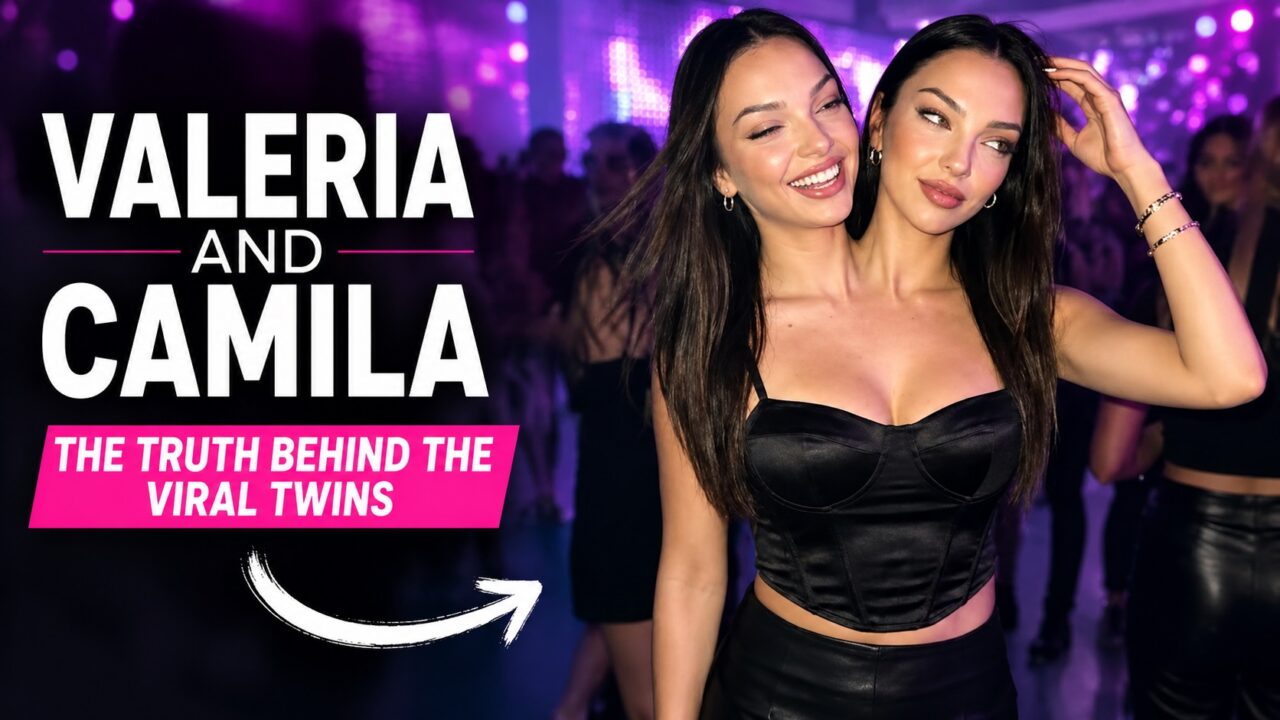

Valeria and Camila became an unexpected social media sensation after appearing online as two women who seemingly share one body. Their glamorous photographs, fashion content, lifestyle videos, and personal stories quickly attracted hundreds of thousands of followers. The unusual concept created an immediate question among internet users: are Valeria and Camila real?
The account presented the pair as conjoined twins living an ordinary influencer lifestyle in Miami. They discussed relationships, work, clothing, food, and their experiences as sisters sharing one body. However, as their popularity increased, so did questions about whether the images and videos represented real people or an elaborate digital creation.
Who Are Valeria and Camila?
Valeria and Camila are the names used by a viral social media duo associated with the Instagram account @itsvaleriaandcamila. The account appeared in December 2025 and rapidly built an audience through highly polished photographs and videos portraying the women as conjoined twins.
According to the profile and its own posts, the pair are 25 years old, based in Miami, and identify as digital creators. Their content combines fashion, travel, lifestyle moments, relationship discussions, and everyday activities. Their unusual presentation made the account stand out from conventional influencer pages.
The account also developed a detailed backstory. Valeria and Camila claimed that each controls one side of their shared body and that they have separate stomachs. They also described having undergone surgeries and explained a visible scar as the result of problems involving their spines.
Why Did Valeria and Camila Go Viral?
The popularity of Valeria and Camila came largely from the unusual nature of their supposed life. Social media users are accustomed to influencers documenting fashion, relationships, vacations, and personal routines, but the idea of two adults living together in one body created an entirely different level of curiosity.
Their posts were designed to look like conventional influencer content. They appeared in fashionable clothing, posed for photographs, attended social events, and shared personal answers with followers. The contrast between an ordinary influencer lifestyle and the extraordinary claim about their physical appearance encouraged people to share, comment, and debate the account.
By early 2026, reports indicated that the account had accumulated roughly 280,000 to nearly 300,000 followers, with more than 100 photographs and videos published since its launch.
Are Valeria and Camila Real?
This is the central question surrounding the viral phenomenon. Although the account portrayed Valeria and Camila as real conjoined twins, multiple media reports and digital-analysis discussions have concluded that the characters are AI-generated.
The account itself has pushed back against accusations that it is artificial. In one video, Camila reportedly responded to the speculation by saying that they move and talk and therefore are not AI. Their posts have also continued to present the pair as real people rather than openly identifying them as fictional digital characters.
However, experts examining the images and videos have pointed to inconsistencies that are difficult to reconcile with normal photography and human anatomy. These include changes in proportions, unusual visual details, inconsistent features between frames, and an exceptionally polished appearance.
AI and digital-forensics specialists have therefore raised strong concerns about the authenticity of the account. One expert described the content as a carefully constructed story designed to generate engagement, while other reporting highlighted visual characteristics associated with synthetic imagery.
The Story Behind the Viral Conjoined-Twin Claim
The idea behind Valeria and Camila appears to be built around a very specific online identity: two heads, one body, and one shared lifestyle. Their content repeatedly reinforces that concept while allowing followers to interact with them as though they were genuine individuals.
They have answered questions about dating, food, clothing, employment, and physical coordination. According to their online claims, both women must agree when dating because they share one body. They also said they tried dating separately but found that arrangement unsuccessful.
Their account reportedly claimed that they work as accountants and receive one salary. They also explained that their clothes are specially tailored to accommodate their unusual physical arrangement. These details helped make the fictional narrative appear more complete and believable to viewers.
Why People Thought Valeria and Camila Were Real
One reason the story gained traction was the realistic quality of modern AI-generated imagery. Earlier generations of synthetic images often contained obvious mistakes, but newer systems can create convincing people, environments, clothing, lighting, and social-media scenes.
Valeria and Camila were presented through dozens of apparently ordinary moments rather than a single unusual photograph. This helped establish continuity around the characters and made the account feel more like a genuine influencer profile.
The pair also interacted with followers and responded to questions, adding another layer to the story. Instead of simply posting artificial images, the account created a personality and lifestyle around the characters. That combination made the mystery more compelling and encouraged viewers to investigate whether the women actually existed.
What Experts Noticed About the Images
Digital analysts examining Valeria and Camila have highlighted several characteristics that can reveal synthetic content. Among the concerns are unusually perfect proportions, unnatural textures, inconsistencies between frames, and changes in body details from one image or video to another.
These issues are especially important when examining a supposed real person across a large collection of photographs. Human physical features normally remain consistent, while generated imagery can subtly alter proportions, hands, facial details, body structure, lighting, and surrounding objects.
The controversy surrounding Valeria and Camila demonstrates why a realistic photograph should not automatically be treated as proof that the person shown actually exists. Modern generative technology can create convincing identities, histories, and environments without a traditional photographic subject being present.
Valeria and Camila and the Rise of Virtual Influencers
The popularity of Valeria and Camila also reflects a larger change in social media. Virtual influencers are becoming increasingly sophisticated, with fictional characters being given personalities, appearances, careers, and online communities.
There is an important distinction, however, between a virtual influencer that openly identifies itself as fictional and an account that presents a generated character as a real person. That difference has become a major part of the discussion surrounding Valeria and Camila.
The controversy is therefore bigger than one Instagram account. It raises questions about transparency, online trust, digital identity, and how audiences determine whether viral content represents reality.
Why the Valeria and Camila Story Matters
The story has become a useful example of how quickly an unusual digital narrative can spread. A compelling visual concept combined with social-media engagement can attract enormous attention before audiences have time to verify the underlying claims.
For users, the lesson is not that every unusual photograph is fake. Instead, it shows why extraordinary online claims deserve careful examination. Reverse-image searches, independent reporting, consistent source material, and expert analysis can all help distinguish genuine people from synthetic characters.
Valeria and Camila also demonstrate how AI-generated personalities can blur the boundary between entertainment and reality. As generated content becomes increasingly convincing, identifying the source and nature of online material will become more important for social media audiences.
Conclusion
Valeria and Camila captured the internet’s attention by presenting an extraordinary story through the familiar language of social media. Their account combined fashion, relationships, lifestyle content, and the claim of being conjoined twins, creating a mystery that quickly attracted a large audience.
Although the account has presented the women as real and has rejected accusations of being AI-generated, reporting and expert analysis have strongly identified the duo as synthetic digital characters.
Ultimately, the biggest story behind Valeria and Camila is not simply whether two women could live the life shown in the posts. It is how convincing AI-generated identities have become and how easily a carefully constructed digital narrative can appear authentic in today’s social-media environment.
FAQs
Who are Valeria and Camila?
Valeria and Camila are the names used by a viral social media duo presented as conjoined twins. Their account became popular through fashion, lifestyle, relationship, and personal-content posts.
Are Valeria and Camila real conjoined twins?
Available reporting and expert analysis indicate that Valeria and Camila are AI-generated digital characters rather than verified real conjoined twins. Their account has disputed claims that the women are artificial.
When did Valeria and Camila become popular?
The Valeria and Camila Instagram account launched in December 2025 and gained substantial attention within a short period. By early 2026, reports said it had attracted hundreds of thousands of followers.
Where are Valeria and Camila supposedly from?
Their social media profile has presented them as being based in Miami, Florida. This location is part of the online identity associated with the account rather than independently verified evidence of two real people.
What do Valeria and Camila claim to do for work?
The account has claimed that Valeria and Camila work as accountants and receive one salary. This is part of the personal backstory presented through their social media content.
Why do people believe Valeria and Camila are AI-generated?
Experts have pointed to visual inconsistencies, unnatural proportions, synthetic-looking textures, and differences between images and video frames. These characteristics have contributed to the conclusion that the characters were digitally generated.
What makes Valeria and Camila different from typical virtual influencers?
The major difference is the controversy over transparency. Many virtual influencers openly identify themselves as fictional or digitally created, while Valeria and Camila have reportedly presented themselves as real people and denied being AI-generated.
Did Valeria and Camila have a large following?
Yes. Reports in early 2026 placed their following at roughly 280,000 to nearly 300,000 people, with more than 100 posts and videos published after the account launched.
Why did the Valeria and Camila story attract so much attention?
The combination of a visually convincing social-media presence and an extraordinary claim about being conjoined twins created a strong curiosity factor. Followers could also interact with the characters, making the fictional narrative feel more personal and authentic.
What can people learn from the Valeria and Camila controversy?
The story shows why social-media users should verify extraordinary claims instead of relying solely on photographs or videos. As generative technology becomes more realistic, checking independent evidence and credible reporting is increasingly important.