
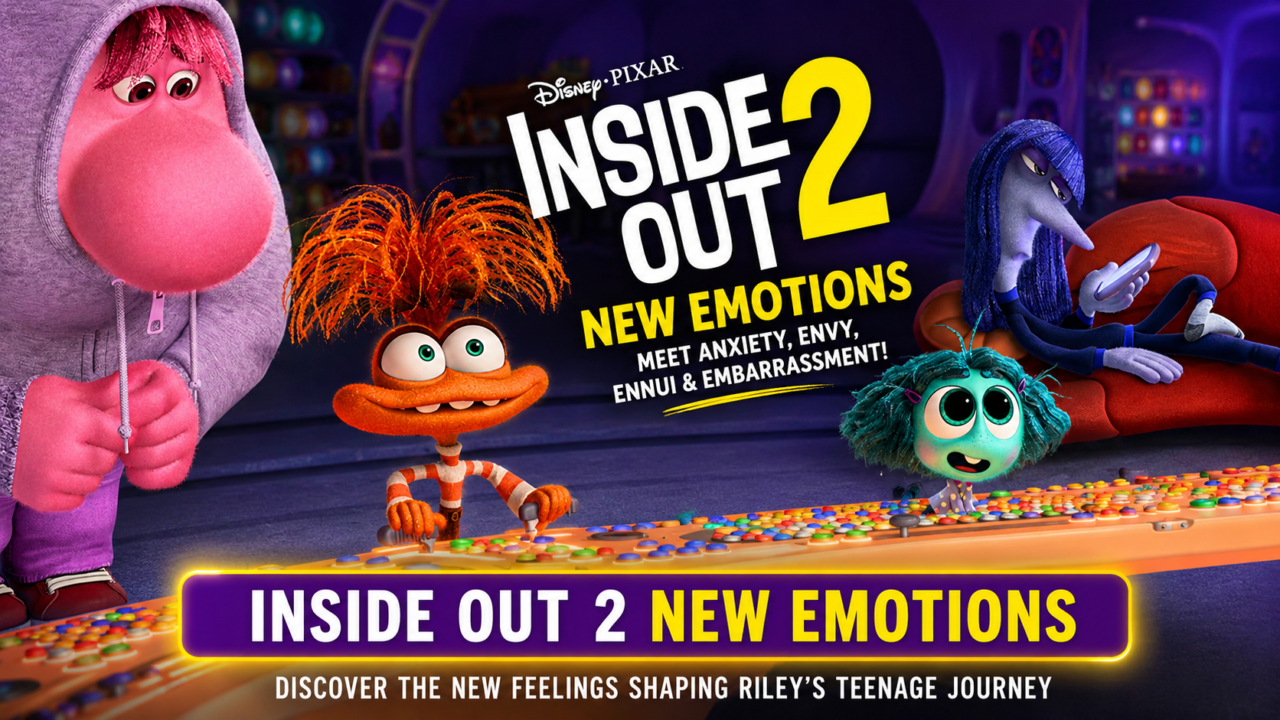

The Inside Out 2 new emotions are one of the biggest reasons Pixar’s sequel feels different from the original movie. When Riley Andersen enters her teenage years, her emotional world becomes much more complicated, introducing a new group of feelings that challenge the emotions audiences already know.
Inside Out 2 expands the story beyond Joy, Sadness, Anger, Fear, and Disgust. The sequel introduces Anxiety, Envy, Ennui, and Embarrassment as major new emotions, while Nostalgia also makes a memorable appearance. Each one represents a different part of Riley’s experience as she grows older.
These new emotions are not simply replacements for the original characters. Instead, they show how Riley’s personality becomes more complex during adolescence. Here is a closer look at the Inside Out 2 new emotions and what each one means.
Who Are the New Emotions in Inside Out 2?
The main new emotions in Inside Out 2 are Anxiety, Envy, Ennui, and Embarrassment. They arrive at Headquarters as Riley enters puberty, creating major changes in the way her mind works.
The new emotions have different personalities and motivations. Anxiety is focused on the future, Envy constantly compares Riley with others, Ennui represents boredom and indifference, and Embarrassment reflects Riley’s growing self-consciousness.
Together, they create a more complicated emotional environment for Riley. Their arrival also causes tension with the original emotions, especially as Anxiety tries to take control of Riley’s personality and decisions.
Anxiety
Anxiety is arguably the most important of the Inside Out 2 new emotions. Voiced by Maya Hawke, Anxiety is energetic, fast-thinking, and constantly concerned about what could happen next.
Unlike Fear, which tends to focus on immediate danger, Anxiety is obsessed with potential future problems. She wants Riley to prepare for every possible outcome, particularly as Riley begins worrying about fitting in and making a good impression.
Anxiety believes that planning ahead will protect Riley from embarrassment, rejection, and failure. Her intentions are not necessarily malicious. In fact, she genuinely believes she is helping Riley succeed.
The problem comes when Anxiety becomes too powerful. Her desire to control Riley’s future pushes the other emotions aside and creates an increasingly stressful internal environment.
Envy
Envy is another major addition to Riley’s emotional team. She represents the tendency to compare yourself with other people and feel that someone else has something you want.
In Riley’s case, Envy becomes particularly relevant when she meets older and more experienced teenagers. Riley starts paying closer attention to popularity, social status, talent, and what other people think of her.
Envy is small in size but expressive in personality. Her role highlights something many teenagers experience: comparing themselves with their peers and wondering whether they are good enough.
The character also demonstrates that envy does not always mean hatred or jealousy. It can simply reflect a desire to have qualities, opportunities, friendships, or experiences that someone else appears to possess.
Ennui
Ennui represents boredom, apathy, and a sense of indifference. The character is presented with a relaxed attitude that contrasts sharply with Anxiety’s constant energy.
Ennui is often associated with Riley’s teenage tendency to appear uninterested or emotionally detached. Her presence helps explain why Riley sometimes responds to situations with a casual attitude even when something important is happening.
The character adds humor to Inside Out 2 while also reflecting a genuine part of growing up. Teenagers can experience intense emotions while simultaneously feeling bored, disconnected, or uninterested in what is happening around them.
Ennui therefore gives Riley’s emotional world another layer. Not every teenage reaction is dramatic. Sometimes the response is simply, “Whatever.”
Embarrassment
Embarrassment is the fourth major new emotion introduced in Inside Out 2. He is a large, shy character who often struggles to communicate openly.
His role reflects Riley’s increasing awareness of how she appears to other people. As children become teenagers, social situations can suddenly feel much more intense. A small mistake can seem enormous when everyone appears to be watching.
Embarrassment represents that uncomfortable feeling of wanting to disappear after doing something awkward. His character also demonstrates that embarrassment can affect behavior even when Riley does not consciously understand why she feels uncomfortable.
Although Embarrassment is quieter than some of the other emotions, he plays an important role in showing Riley’s emotional development.
Nostalgia Makes a Brief Appearance
Nostalgia is also part of the Inside Out 2 emotional lineup, although she does not play the same major role as Anxiety, Envy, Ennui, and Embarrassment.
Nostalgia represents the warm, sentimental feeling associated with remembering the past. Her appearance is brief and comedic, but the character fits naturally into a story about Riley growing older.
As Riley moves further into adolescence, her childhood becomes something she can look back on. Nostalgia represents that emotional connection to earlier experiences and memories.
Her brief presence is also a reminder that emotional development does not mean getting rid of childhood feelings. Instead, new emotions are added to an increasingly complicated inner world.
How the New Emotions Change Riley
The arrival of the Inside Out 2 new emotions changes the balance inside Headquarters. Riley is no longer dealing only with the relatively straightforward emotional challenges of childhood.
As she enters her teenage years, Riley becomes more concerned about friendship, popularity, identity, and the person she wants to become. Anxiety interprets these challenges as problems that need to be solved before they happen.
This creates a conflict between the original emotions and the newcomers. Joy wants Riley to remain true to herself, while Anxiety believes Riley needs to change in order to succeed socially.
The central conflict demonstrates an important idea: growing up does not mean one emotion should control everything. Riley needs all of her emotions, including the uncomfortable ones, to understand herself properly.
Why Inside Out 2 Needed New Emotions
The original Inside Out focused heavily on the emotional experiences of childhood. Riley was dealing with moving to a new city, missing her old home, adjusting to change, and trying to understand her feelings.
Inside Out 2 moves into adolescence, a stage of life that naturally introduces different emotional challenges. Social pressure becomes stronger, self-consciousness increases, and people begin thinking more about identity and the future.
That is why the Inside Out 2 new emotions feel necessary rather than simply added for the sequel. They represent psychological changes that become more noticeable as Riley grows older.
The new characters also allow Pixar to explore emotions that are more difficult to define. Anxiety, envy, boredom, and embarrassment can influence decisions without always being easy to recognize.
Inside Out 2 New Emotions vs. the Original Emotions
The original emotional team consists of Joy, Sadness, Anger, Fear, and Disgust. These characters continue to play important roles in Riley’s mind, but they have to adapt to the arrival of the new emotions.
The biggest difference is that Riley’s emotional life is no longer as simple as it was when she was younger. Her feelings increasingly overlap. She can be excited and nervous at the same time, proud while feeling insecure, or happy while worrying about what comes next.
The sequel uses these characters to show that emotional maturity is not about eliminating negative feelings. Instead, it involves learning how different emotions work together.
What Anxiety Represents in Riley’s Story
Anxiety is especially important because she represents a feeling that many people experience during adolescence. Riley starts thinking about future consequences and how her current choices might affect her life.
Anxiety tries to protect Riley by predicting possible problems. However, constantly preparing for things that have not happened can prevent Riley from enjoying the present.
The movie uses this conflict to show how anxiety can become overwhelming when it takes complete control. Riley ultimately needs to understand that she does not have to become a perfect version of herself to be accepted by others.
The Bigger Message Behind the New Emotions
The Inside Out 2 new emotions support the movie’s broader message about identity and self-acceptance. Riley’s personality is not created by a single emotion or a single experience.
As she grows, her sense of self becomes more complicated. She experiences success, disappointment, embarrassment, excitement, fear, jealousy, and uncertainty. All of these experiences contribute to the person she becomes.
The sequel suggests that emotional health is not about always feeling happy. Riley needs space for uncomfortable emotions as well as positive ones.
That message makes the new emotions more than colorful supporting characters. They are representations of experiences that become increasingly important as people grow up.
Conclusion
The Inside Out 2 new emotions bring an important new dimension to Pixar’s emotional universe. Anxiety, Envy, Ennui, and Embarrassment each represent challenges associated with adolescence, while Nostalgia adds a brief reminder of Riley’s childhood.
Among them, Anxiety has the largest influence on the story, but every new emotion serves a distinct purpose. Together, they demonstrate how complicated growing up can be and why no single emotion can completely define who Riley is.
Ultimately, Inside Out 2 shows that becoming a teenager is not about choosing between positive and negative emotions. It is about learning to accept the entire emotional experience and understanding how those feelings shape identity.
FAQs
What are the new emotions in Inside Out 2?
The main Inside Out 2 new emotions are Anxiety, Envy, Ennui, and Embarrassment. Nostalgia also appears briefly in the movie.
Who is the most important new emotion in Inside Out 2?
Anxiety has the largest role among the Inside Out 2 new emotions. She becomes deeply involved in Riley’s decisions and tries to control her future.
Is Fear the same as Anxiety in Inside Out 2?
No. Fear generally reacts to immediate danger, while Anxiety focuses more on possible future problems and negative outcomes.
What does Envy represent in Inside Out 2?
Envy represents comparison and the desire to have qualities or experiences that other people appear to possess. Riley experiences these feelings more strongly as she becomes concerned with social acceptance.
What does Ennui mean in Inside Out 2?
Ennui represents boredom, apathy, and indifference. The character reflects Riley’s increasingly complicated teenage reactions to situations around her.
What does Embarrassment represent in Inside Out 2?
Embarrassment represents Riley’s growing self-consciousness and discomfort in awkward social situations. His character reflects the heightened awareness many teenagers develop about how others perceive them.
Is Nostalgia one of the new emotions in Inside Out 2?
Yes, Nostalgia appears as a new emotion, but she has a much smaller role than Anxiety, Envy, Ennui, and Embarrassment.
Why does Riley get new emotions in Inside Out 2?
Riley enters adolescence, bringing new social, emotional, and psychological challenges. The new emotions represent feelings that become more prominent as she grows older.
Do the original emotions return in Inside Out 2?
Yes. Joy, Sadness, Anger, Fear, and Disgust all return. The sequel brings them together with Riley’s new emotions as her emotional world becomes more complicated.
What is the main message of the new emotions in Inside Out 2?
The new emotions show that growing up involves accepting a wide range of feelings. Riley does not need to eliminate uncomfortable emotions; she needs to understand how all of her emotions contribute to her identity.